09 Feb Recovering territories: a long-term environmental, social and economic investment
Recovering territories: a long-term environmental, social and economic investment
The recovery of polluted soil and water has become one of the great environmental and territorial challenges of the coming decades. Former industrial areas, closed landfills or spaces degraded by past activities today represent not only an environmental liability, but also a strategic opportunity for sustainable development.
It must be considered that these urban areas where land is very valuable to house new facilities such as schools, hospitals, parks and areas with common spaces, housing… the well-being of the people must be ensured and this involves regenerating the subsoil.
Far from being a one-off action, environmental remediation is a complex technical process that combines diagnosis, intervention and long-term monitoring. Its objective is not only to eliminate pollutants, but also to ensure that the territory can recover safe uses that are compatible with its environment and its community.
Polluted soil limits the urban, economic and social development of a territory. Their recovery makes it possible to unlock spaces that would otherwise remain unused for decades. Disused industrial areas can be transformed into productive areas, natural spaces or green infrastructures that add real value to the territory.
In addition, these processes reduce risks to human health, improve environmental quality and contribute to more efficient territorial planning, aligned with the objectives of sustainability and circular economy.
Decontamination has a direct effect on ecosystems. Improving soil and water quality promotes the recovery of basic ecological functions and allows biodiversity to be progressively re-established. This process, based on scientific and technical criteria, is key to restoring environmental balances that have been altered for years.
Environmental monitoring after remediation is essential to ensure the stability of results and the safety of new land uses.
Each recovery project is unique and must be approached with an in-depth knowledge of the site, its history and its context. The characterization of the terrain, the selection of appropriate technologies and the management of the associated risks are critical phases to ensure the success of the action.
We can find old industrial areas that present problems of bad smells and leaks of contaminated water as a result of poor soil recovery. Or expanding companies that want to grow responsibly and assume the environmental liabilities of the past so that they understand that they have to generate wealth in healthy environments.
Polluted soil affects the water cycle Portability is threatened by the presence of contaminants in the water and subsoil.
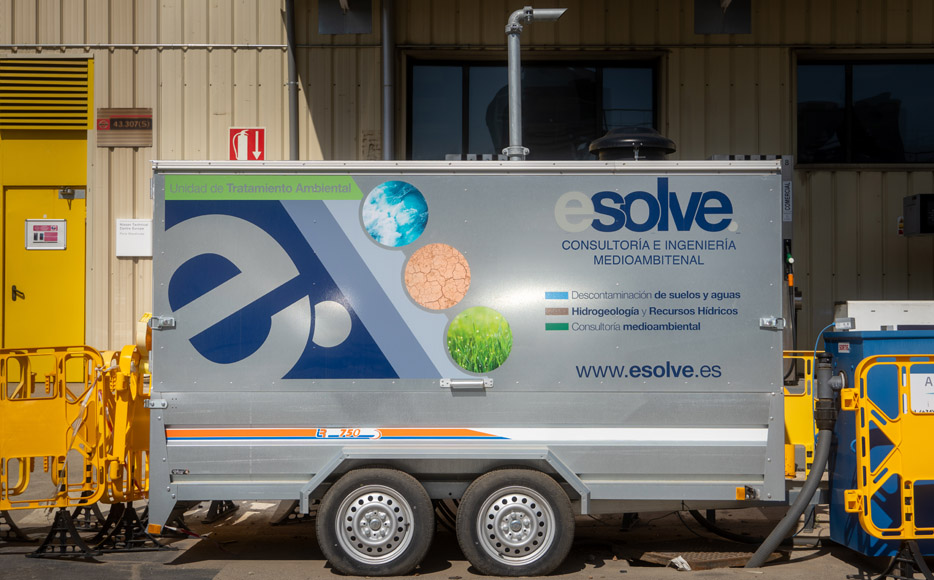
That is why at ESOLVE we approach environmental recovery from a comprehensive perspective, combining engineering, consulting and environmental monitoring to offer solutions adapted to each case. Our goal is to turn degraded spaces into functional, safe territories with a future.
The recovery of soil and water is not only a response to a problem of the past, but a key tool for building more resilient, sustainable territories prepared for the environmental challenges of the present and the future.