

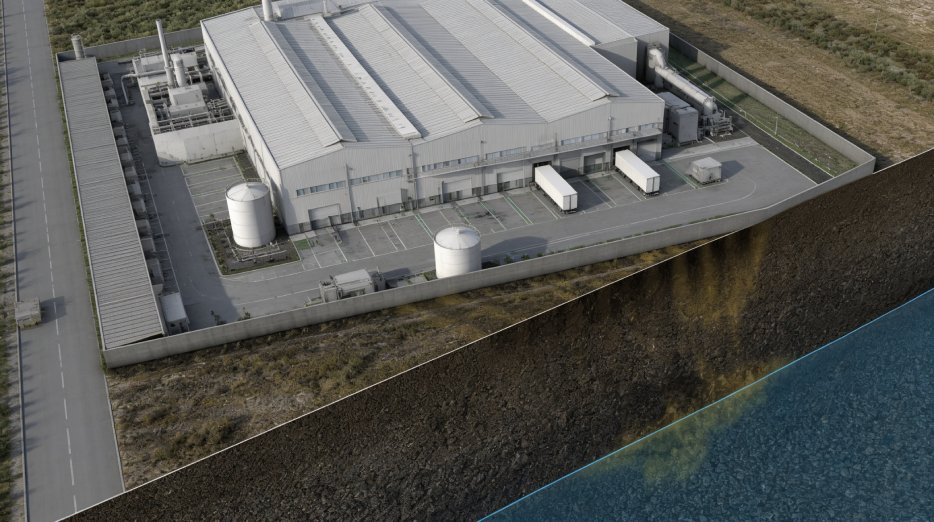
18 Jun Industrial floor contamination: the invisible risk that can affect your company.
Industrial floor contamination: the invisible risk that can affect your company.
Soil pollution is no longer just an environmental issue. Today it also represents an operational, regulatory and economic risk for many industries.
For years, numerous subsoil conditions have remained invisible until they appear at the worst possible time: an environmental audit, a purchase and sale operation, an industrial expansion or a regulatory change.
And the current context is accelerating that pressure. Regulatory developments, the monitoring of persistent pollutants and the growing demand for sustainability are forcing companies to anticipate risks that may have previously gone unnoticed.
Especially in industrial, energy, logistics or waste management sectors, the management of contaminated soil has become a strategic issue.
What is soil pollution?
Soil contamination occurs when chemical substances or residues alter its natural characteristics and create a risk to human health, ecosystems or the industrial environment.
In many cases, the problem does not appear immediately. Certain pollutants can remain for years in the subsoil, migrating slowly and increasing the technical and economic complexity of their management.
It is precisely this ability to evolve silently that makes soil contamination one of the most difficult environmental risks to detect in time.
Main causes of industrial soil pollution
Although each site has specific characteristics, there are several recurrent outbreaks that are still responsible for a large part of the conditions currently detected.
Chemical leaks and spills
Small losses repeated over years can cause significant contamination without visible evidence on the surface.
Fuels, solvents, hydrocarbons, industrial oils or certain chemical compounds can progressively infiltrate the ground if they are not detected in time.
Tanks and buried pipelines
Buried infrastructure continues to be one of the main historical sources of soil contamination.
Corrosion, ageing materials or lack of maintenance can lead to leaks that are difficult to identify at an early stage.
Historical waste management
Many industrial sites maintain environmental liabilities associated with practices carried out decades ago under regulatory frameworks that are very different from those of today.
This causes certain conditions to appear years later, especially during industrial transformation processes, changes in land use or corporate transactions.
How to detect possible soil contamination?
One of the main challenges of soil contamination is that it rarely shows obvious signs in its early stages.
For this reason, early identification requires specific environmental investigations that allow us to know the real state of the subsoil and evaluate possible associated risks.
Among the main tools used are:
- Exploratory and detailed research.
- Soil and groundwater sampling campaigns.
- Chemical laboratory analysis.
- Preparation of conceptual models of the site.
- Quantitative risk assessments.
Acting preventively allows conditions to be detected before they generate significant operational, regulatory or economic impacts.
Risks associated with contaminated soils
The impact of contaminated soil goes far beyond the environmental dimension.
The consequences can directly affect:
- Operational continuity.
- The viability of projects.
- Corporate reputation.
- The value of assets.
- Regulatory compliance.
The main risks include:
- Increased remediation costs.
- Limitations on future use of the site.
- Delays in industrial or urban planning operations.
- Legal and administrative responsibilities.
- Reputational impacts on investors, administrations and stakeholders.
In many cases, the true magnitude of the problem can only be determined by an environmental risk analysis.
The importance of acting preventively
In environmental management, acting late usually translates into more complex interventions, higher costs and less decision-making power.
That is why more and more companies are betting on preventive strategies based on:
- Early environmental research.
- Characterization of the subsoil.
- Risk assessment.
- Environmental monitoring.
- Advanced decontamination technologies tailored to each site.
The emergence of complex and persistent pollutants, such as PFAS, is also driving the development of new remediation solutions, on-site treatments and advanced technologies capable of improving the efficiency and sustainability of decontamination processes.
The key is no longer just to decontaminate when the problem appears. The real difference is in anticipating the risk before it impacts the operation or the business.
A new approach to soil decontamination
The current complexity of pollutants requires solutions capable of combining technical knowledge, innovation and the ability to act in real industrial environments.
At ESOLVE we develop research, characterisation and soil decontamination projects from an integrated perspective, adapting each solution to the specific needs of each site and pollutant.
Because today, correctly managing contaminated soil is not only an environmental obligation. It is also a strategic decision to reduce risks, protect assets and ensure the continuity of industrial activity.
Are you planning to carry out a sale of assets, an industrial expansion or do you need to assess possible environmental risks?
At ESOLVE we carry out soil quality research, risk analysis and decontamination projects adapted to each case.
Our team can help you identify, characterize, and manage soil contamination before it becomes an operational, economic, or regulatory issue. Request a personalized study.

Sorry, the comment form is closed at this time.