

28 May ESOLVE addresses the challenge of PFAS in the WaterTalks: how to respond to the new “nanogram era”
ESOLVE addresses the challenge of PFAS in the WaterTalks: how to respond to the new “nanogram era”
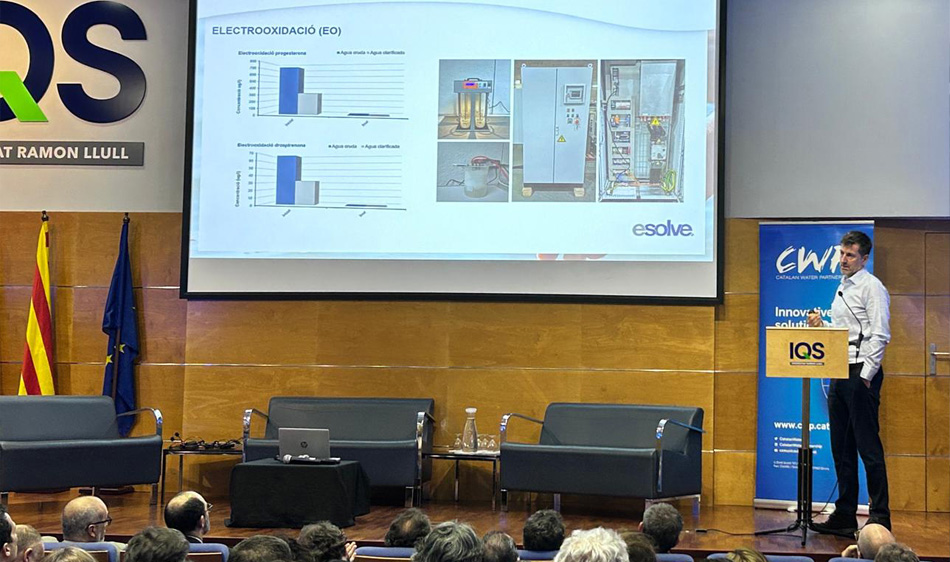
On 14th May, Ricard Mora, Managing Director of ESOLVE, participated as a speaker in the WaterTalks organised by the Catalan Water Partnership (CWP), Eurecat, ICRA and IQS, a conference focused on one of the great challenges that is already impacting European industry: the management of PFAS and other emerging pollutants.
Under the title “The challenge of PFAS: from the regulatory threat to the definitive solution”, the presentation addressed how the new European regulatory framework is forcing many organizations to rethink the management of their waters, aquifers and environmental assets.
A paradigm shift that ESOLVE defines as “the nanogram era”: a scenario where regulatory limits drop to extremely low concentrations and where many current infrastructures were not designed to respond to these levels of demand.
New PFAS regulation forces anticipation
PFAS (per-and polyfluoroalkyl compounds), known as “permaylated pollutants” due to their high persistence in the environment, have become one of the main regulatory priorities of the European Union.
Currently, Royal Decree 3/2023 already sets specific limits for PFAS in water for human consumption, while the new European directives for surface and groundwater pose even more restrictive requirements, placing certain priority compounds at levels in the order of nanograms per liter.
This new scenario poses a technical, economic and operational challenge for numerous industrial sectors, especially those with a possible impact on process water, aquifers or soils.
For many organizations, the issue is no longer just to comply with current regulations, but to anticipate future regulatory restrictions that could affect:
- operational continuity,
- the management of environmental assets,
- administrative authorisations,
- future remediation and treatment costs.
ESOLVE’s own technology to act directly on the source of contamination
Faced with this scenario, its comprehensive approach to the management and elimination of PFAS, based on technologies capable of not only separating the contaminant, but also destroying it effectively, was presented at the WaterTalks.
One of the central points of the presentation was the presentation of ESOLVE’s own plug-and-play electrooxidation plant , a mobile solution designed to work directly on site and adapt to different industrial and environmental environments.
The technology makes it possible to intervene directly on the source of contamination without the need for large permanent infrastructures, reducing implementation times, operational complexity and costs associated with treatment.
In addition, electrooxidation allows the chemical bonds of PFAS/APIS to be destroyed and the problem avoids transferring the problem to other media or to future waste management costs and environmental liabilities.
The plant is part of the comprehensive treatment train, which combines:
- separative and concentrative technologies,
- Surfactant Foam Fractionation (SAFF)
- anion exchange resins (AEX),
- Advanced destructive technologies based on electrooxidation.
This model allows each solution to be adapted to the specific characteristics of the site and the type of contamination present.
Solutions applicable in a real environment for a challenge that is no longer future
ESOLVE’s participation in the WaterTalks reinforces the company’s position as an engineering company specialising in emerging pollutants and in the development of technological solutions applicable in real industrial environments.
In a context where regulation evolves faster than many existing infrastructures, the ability to act in an agile, flexible and direct way on the ground will be key to reducing regulatory, operational and economic risks.
Adapting to the new PFAS regulation is no longer a future issue. For many industries, anticipating now will make the difference between managing risk in a controlled way or facing much more complex and costly adaptation processes in the coming years.
Are you concerned about the impact of the new PFAS regulation on your assets, process water, or industrial sites?
At ESOLVE we help organisations assess their vulnerability to emerging contaminants through specialised diagnostics and treatment strategies adapted to each industrial reality.
Contact our technical team to analyse your scenario and define a tailor-made action plan.

Sorry, the comment form is closed at this time.