

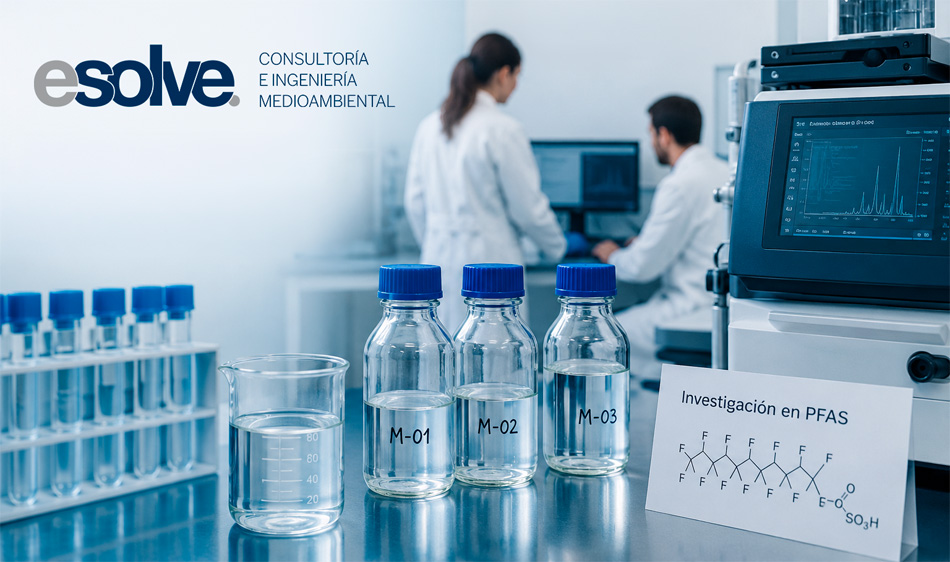
18 May ESOLVE promotes research into PFAS in contaminated water in collaboration with the CSIC
ESOLVE promotes research into PFAS in contaminated water in collaboration with the CSIC
The collaboration with the Spanish National Research Council (CSIC) reinforces ESOLVE’s commitment to the analysis and search for solutions to PFAS, one of the greatest challenges in groundwater pollution.
PFAS (per-and polyfluoroalkyl substances), known as “Eternal pollutants”, represent today one of the most complex challenges in environmental management. Its high persistence, its capacity for mobility in the environment and its resistance to degradation mean that its presence in groundwater requires a Technical Approach and a clear commitment to research.
In this context, ESOLVE has initiated a collaboration with the Spanish National Research Council (CSIC), through the Institute of Microelectronics of Barcelona (IMB-CNM) y, specifically, by the researcher Borja Sepúlveda in the Micro and Nanotools Group (MNTL), with the aim of continuing to deepen the analysis of water contaminated with PFAS and advance in the knowledge of its behavior in real conditions.
Applied research to address emerging contaminants
The collaboration is based on the study of groundwater samples managed by ESOLVE within the framework of its projects. This joint work makes it possible to connect the Field Experience with scientific knowledge, a key step to better understand the presence and evolution of PFAS in complex environments.
This type of initiative responds to a growing need in the sector: to integrate applied research into the Soil and water pollution management. It is not just a matter of identifying the problem, but of continuing to generate knowledge that allows it to be addressed more effectively.
Collaboration with reference centres
Working with institutions such as the CSIC is part of ESOLVE’s strategy to promote solutions based on science and evidence. Collaboration with research centres makes it possible to advance in the analysis of emerging pollutants and to strengthen the technical quality of the projects.
At the same time, such partnerships contribute to accelerating the development of new approaches in the PFAS Treatment, an area that is constantly evolving due to the complexity of these compounds.
An ongoing commitment to environmental innovation
This collaboration is part of ESOLVE’s commitment to innovate in soil and water decontamination. In the face of persistent pollutants such as PFAS, the answer necessarily involves continuing research, contrasting approaches and working in coordination with the scientific environment.
Because pollution management is not static. It evolves at the pace of knowledge.
And this is precisely where the collaboration between engineering and science makes the difference.
Learn more about the emerging contaminants and the impact of PFAS on water and soil here.

Sorry, the comment form is closed at this time.