

28 Oct MITECO Guide to Contaminated Aquifers: Keys for Companies
MITECO Guide to Contaminated Aquifers: Keys for Companies
MITECO brings together in four volumes the technical criteria for investigating the point contamination of groundwater, assessing the risks and defining recovery actions. A reference documentation for companies that need to know the environmental status of their facilities and make informed decisions in the event of a possible impact on the subsoil.
Groundwater pollution poses an environmental challenge that is not always visible from the surface. A leak from a tank, a leak in a pipeline or inadequate management of substances and waste can cause an impact on the subsoil whose extent must be investigated.
The Ministry for the Ecological Transition and the Demographic Challenge (MITECO) brings together on its website the Technical Guide to the Management of Aquifers Contaminated by Point Sources, consisting of four volumes dedicated to research, risk assessment, decontamination and administrative procedures.
This documentation develops technical criteria related to the groundwater protection framework established in the Hydraulic Public Domain Regulations, amended by Royal Decree 665/2023, of 18 July. The guide serves as a technical reference; the applicable obligations must be determined in accordance with current regulations and the circumstances of each site.
- What does the MITECO technical guide address?
The guide organizes the main aspects of spot groundwater pollution management into four volumes:
- Volume 1. Groundwater investigation. It addresses the necessary investigation to know the condition, characterize the site and determine the extent of the contamination.
- Volume 2. Quantitative risk analysis. It focuses on the assessment of the risks associated with the contaminants detected, taking into account the substances present, the routes of exposure and the possible receptors.
- Volume 3. Groundwater decontamination. It deals with the technical aspects related to the definition and execution of actions to recover the quality of groundwater.
- Volume 4. Administrative procedures for punctual pollution. It includes aspects related to the processing and administrative management of these pollution episodes.
Together, the documents provide a reference for addressing the different phases of managing a contaminated aquifer, from initial research to reclamation actions and their administrative fit.
- What does it mean for companies with industrial facilities?
Companies that carry out industrial activities may encounter situations of groundwater contamination associated with both recent incidents and historical conditions. Possible sources include leaks from buried tanks, leaks in pipelines, spills of chemical substances or the infiltration of pollutants from waste storage and management areas.
The detection of a pollutant in groundwater alone does not determine the magnitude of the problem or the necessary solution. Informed decisions require knowledge of the geological and hydrogeological context, identification of foci, delimitation of the distribution of contaminants, and assessment of potential migration and exposure pathways.
This diagnosis is especially relevant in facilities located in consolidated industrial estates, sites with historical activity or land where an acquisition, transformation or change of use is proposed.
The Hydraulic Public Domain Regulations establish procedures to characterise and diagnose the point contamination of groundwater, assess the risks and determine the corresponding actions. The application of these procedures depends on the circumstances of the site and the decisions of the hydraulic administration.
Having reliable technical information helps companies to anticipate action needs and properly manage their environmental responsibilities.
- From research to decontamination: why diagnosis is decisive
Managing a contaminated aquifer doesn’t start with choosing a treatment technology. It starts with research.
The characterisation of the subsoil and groundwater makes it possible to establish a conceptual model of the site: where the focus is located, what substances are present, how they can move and what elements of the environment could be affected.
Based on this information, it is possible to assess the need to carry out a quantitative risk analysis, establish action objectives and compare the available decontamination alternatives.
The choice of solution depends on factors such as the properties of the contaminants, geology, hydrogeology, extent of the condition and the conditions of the installation. In certain cases, it may be necessary to carry out treatability tests or pilot tests to check the performance of a technology before designing a full-scale intervention.
Subsequent monitoring makes it possible to check the evolution of concentrations, evaluate the effectiveness of the actions and determine whether the established objectives are being achieved.
There is no single solution for all contaminated aquifers. Effective intervention requires understanding the problem and adapting the strategy to the actual conditions of the site.
- How ESOLVE can help businesses
At ESOLVE we work on the research and recovery of soil and groundwater, accompanying companies from the initial characterisation to the design of decontamination solutions and the monitoring of their evolution.
Our work may include:
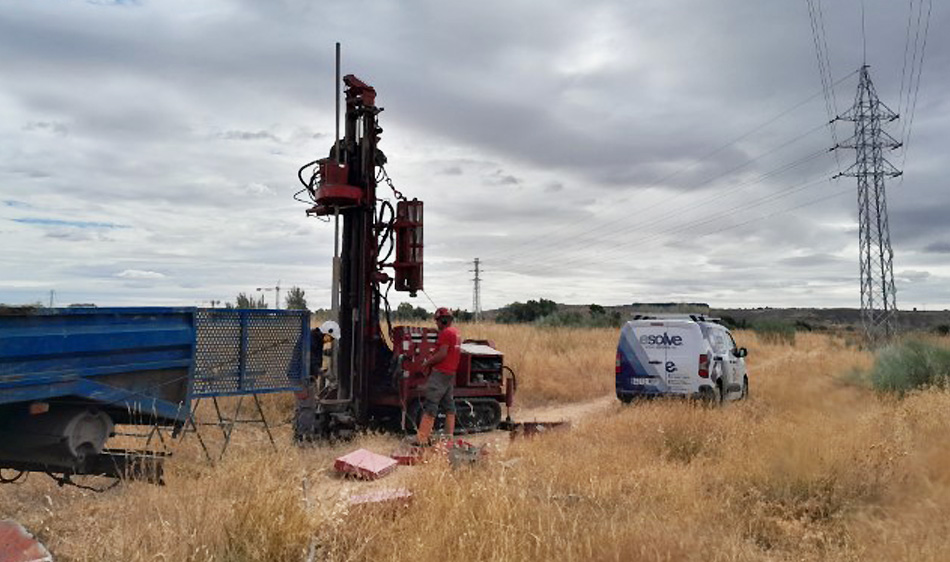
- Environmental research and characterization: execution of soundings, sampling and analysis to know the state of the soil and groundwater.
- Hydrogeological characterization: study of subsurface conditions and water movement to understand the distribution and possible migration of pollutants.
- Risk assessment: analysis of potential routes of exposure and potentially affected receptors.
- Design of decontamination solutions: selection and evaluation of alternatives adapted to contaminants, site characteristics and recovery objectives.
- Pilot tests and follow-up: checking the behaviour of solutions when necessary and monitoring their effectiveness during intervention.
The aim is for environmental decisions to be based on data, scientific criteria and solutions tailored to each case, taking into account both the protection of the environment and the operating conditions of the facility.
- Check the official documentation
MITECO brings together the technical guide and other documentation related to the protection of groundwater against point pollution on its official website.
- Technical guide for the management of aquifers contaminated by point sources and documentation from MITECO.
- Royal Decree 665/2023, of 18 July, in the BOE.
The technical guide is a support document for the interpretation and application of technical criteria. The determination of the obligations applicable to each site must be carried out in accordance with the regulations in force and the specific circumstances of the case.

Sorry, the comment form is closed at this time.